Why Professionals Choose Cultured Stone Containers
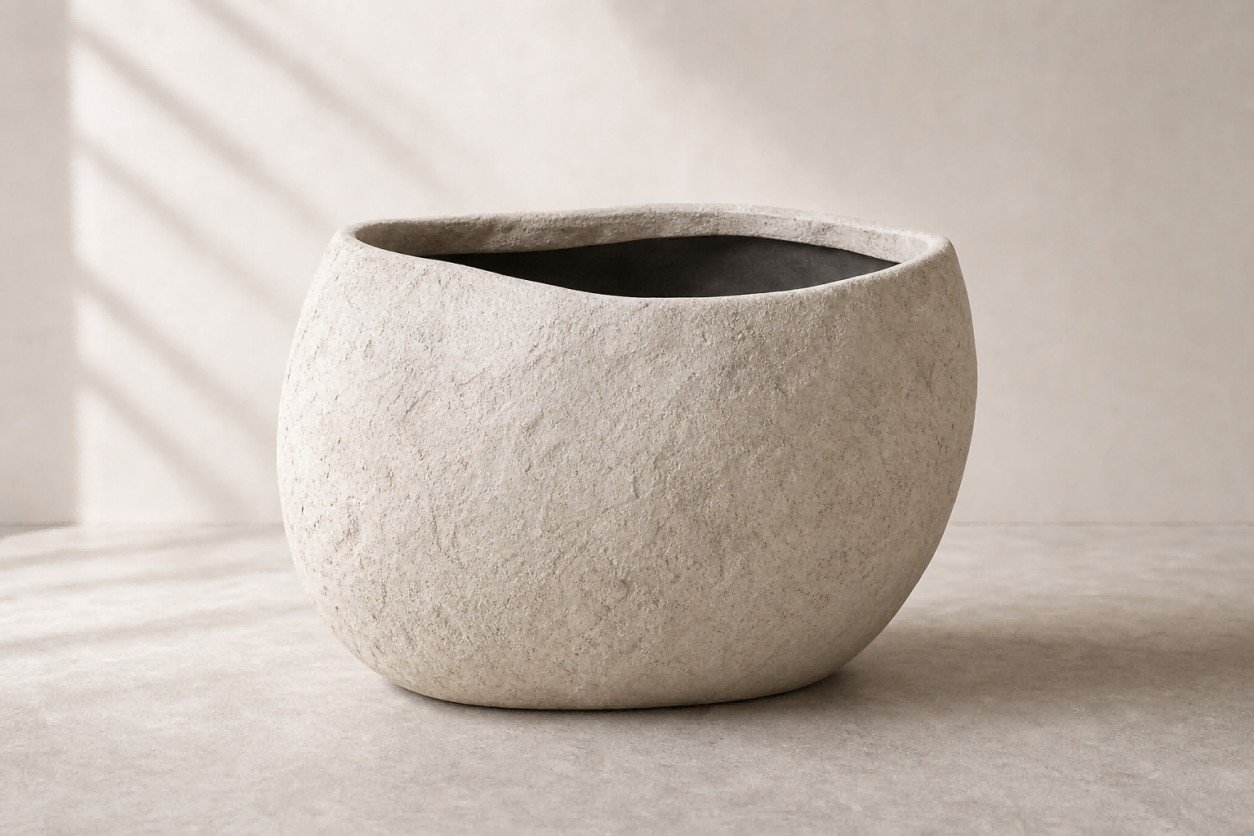
Cement planters have a matte, rough industrial and wabi-sabi style, with high compressive strength and low raw material cost. They are suitable for minimalist commercial spaces, industrial-style cafes, and outdoor landscape greening.
Their limitations are obvious: they are porous, prone to efflorescence (white alkali deposits) in humid environments, heavy in weight, and have average frost resistance. New cement planters may leach free alkali and burn plant roots, so pre-washing or lining is recommended

Magnesium oxide planters are ultra-light — only about 1/3 the weight of cement planters of the same size — with high cost performance and good fire resistance. They are the most cost-effective choice for large-area indoor soft decoration, exhibition layout, and temporary commercial display.
The main limitation is that in high-temperature and high-humidity environments or long-term outdoor rain, it is prone to halogen reversion (surface moisture and whitening), which affects appearance and structural durability. It is not recommended for long-term outdoor use in rainy and humid southern regions.
Resin-based artificial stone: 15–25 years for commercial grade, with stable appearance and structure for long-term outdoor use.Cement-based concrete: 10–20 years, the service life in northern freeze-thaw and southern humid environments will be shortened by 3–5 years.